Typical range $150–$650
Water heater leaks
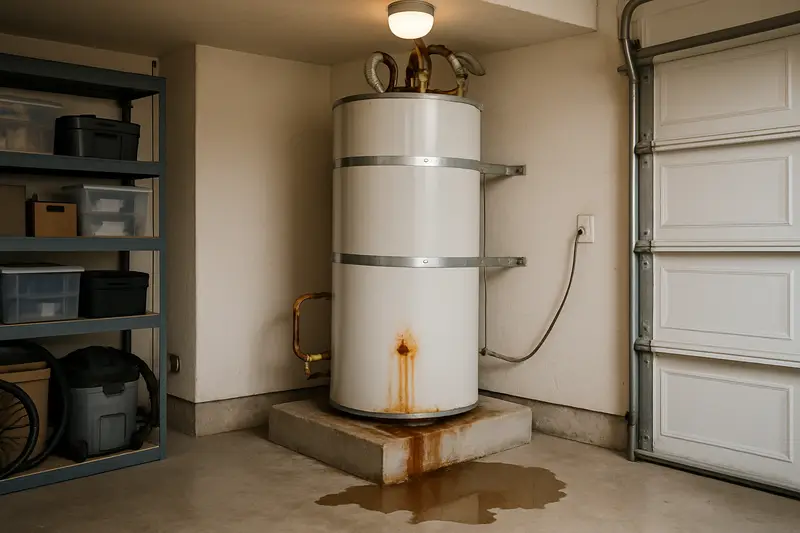
Where a water heater is leaking from decides almost everything: a drip from a fitting at the top is usually a small repair, while water seeping from the bottom of the tank usually means the tank itself has failed.
Answered 24/7
Nights, weekends, holidays
Licensed local plumbers
Licensed in California
Pinpoint locating
Acoustic, thermal, tracer gas
Price ranges up front
Know the range before they come
Signs that point here
- A puddle or rust-coloured water in the drain pan
- Dripping from the pipe on the side of the tank (the relief valve line)
- Moisture or corrosion on the fittings at the top
- Water seeping from the base of the tank itself
- Rumbling or popping when the burner runs, plus rusty hot water
Read the leak by where it is
| Where the water is | Likely cause | Usually |
|---|---|---|
| Top of the tank, at the pipes | Loose or corroded connector, failing shut-off valve | Repair |
| Relief valve or its discharge pipe | Excess pressure or temperature, or a worn valve | Repair, and check the expansion tank |
| Drain valve near the bottom | Worn or loose drain valve | Repair |
| Under the tank, from the jacket | Inner tank has corroded through | Replace |
| Pan is wet but tank looks dry | Condensation, or a slab leak near the heater | Investigate |
Why tanks wear out faster in this region
Southern California water is hard, and that scale settles at the bottom of a tank, insulating the water from the burner. The steel underneath runs hotter, the sacrificial anode rod is used up sooner, and the tank begins to corrode. Many tanks here reach the end of their life somewhere between 8 and 12 years, sooner if they've never been flushed.
The date of manufacture is coded into the serial number on the label. If the heater is past ten years and leaking from the tank, a repair rarely makes sense.
California requirements for replacements
- Seismic strapping (two straps on the upper and lower thirds of the tank) is required by state law for new or replacement water heaters.
- Most cities require a permit for a water heater replacement; a licensed plumber will normally pull it.
- An expansion tank is commonly required where the home has a pressure regulator or check valve.
- Gas units need correct venting and combustion air; garage installs typically sit on an 18-inch platform.
What to do right now
- 1
Turn off the heat source
On a gas heater, turn the control knob to Off or Pilot. On an electric heater, switch off its breaker.
- 2
Shut the cold inlet
Close the valve on the cold-water pipe at the top of the tank. This stops new water feeding the leak; the rest of the house keeps cold water.
- 3
Contain the water
If there's no drain pan, use towels or a wet vac. Keep water away from the burner and any electrical connections.
- 4
Don't drain it yourself if it's corroded
Opening an old drain valve can make it leak worse. Leave draining to the plumber unless you're comfortable with it.
Questions people ask
Can a leaking water heater be repaired?+
If the leak is from a fitting, a valve or the relief valve, usually yes. If water is coming from the tank body itself, it needs replacing.
Is a leaking water heater dangerous?+
The bigger risks are water damage and, rarely, a relief valve that's leaking because of dangerous pressure or temperature. Turn off the heat and the inlet valve and have it checked.
How long do water heaters last in Southern California?+
Commonly 8 to 12 years for a tank unit, depending on water hardness and maintenance. Tankless units often last longer with regular descaling.
Do I need a permit to replace a water heater?+
Most cities in Orange and Los Angeles counties require one. A licensed plumber will normally handle the permit and the inspection.