Guide · updated 2026-10-02
Why your water bill suddenly jumped
Before assuming a billing error or a leak under the house, work through the cheap explanations in order. Most surprise bills are solved in the first three steps, and the rest narrow the search so a plumber spends less time finding it.
Step 0: compare like with like
Southern California bills are usually every one or two months, and summer bills are naturally higher because irrigation can be half or more of a household's use. Compare the bill with the same period last year, not with last month. Also check the number of days in the billing period and whether the rate tier changed. Many agencies charge more per unit once you pass a tier threshold, so a modest increase in use can produce a bigger jump in dollars.
If use (shown in billing units or hundred cubic feet, HCF) is up 30% or more against last year and nothing changed at home (no guests, no new lawn, no pool fill), keep going.
Step 1: watch the meter
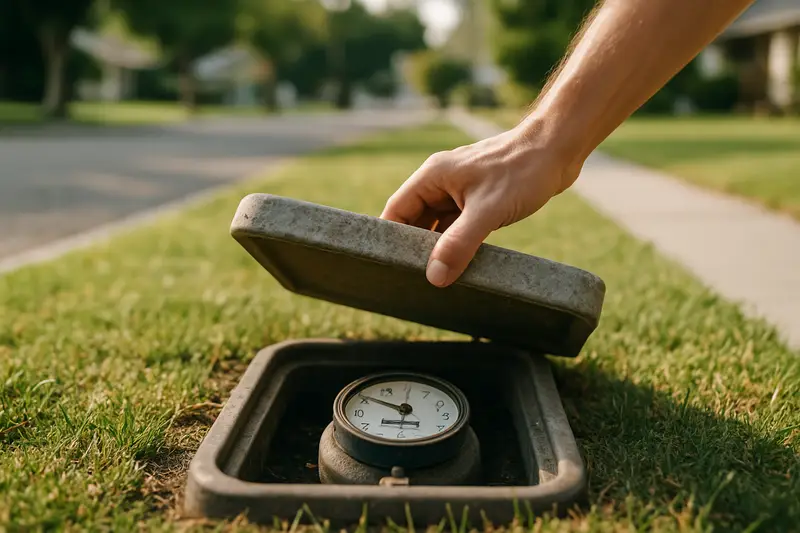
The meter is usually in a concrete box near the curb, with a lid you can lever up with a screwdriver. Inside, besides the main dial, there's a small triangle, star or gear: the low-flow or leak indicator. It spins with even a trickle of water.
Turn off every tap, the dishwasher, washing machine, ice maker, evaporative cooler and the irrigation controller. Watch the indicator for two minutes. If it moves, water is leaving the system right now.
For slow leaks, do an overnight test: write down the full meter reading after the last use at night and again before anyone uses water in the morning. Any difference is water you didn't use.
Step 2: test the toilets
Toilets are the most common cause of silent waste. A flapper that's warped or coated with mineral scale lets water seep from the tank into the bowl, and the fill valve tops it up every few minutes, often too quietly to hear.
Put a few drops of food colouring in each tank. Don't flush for 15–20 minutes. If colour appears in the bowl, that toilet is leaking. A new flapper is a few dollars at a hardware store; a fill valve that runs continuously or hisses is a slightly bigger job.
Step 3: rule the irrigation in or out
Irrigation valves fail open, drip-line fittings pop off under pressure, and sprinkler heads get broken by mowers. Because the system usually runs at night, nobody sees it. Signs include a corner of the yard that's always soggy, water running down the gutter in the morning, or a valve box with water standing in it.
Switch the controller off for 24 hours and repeat the meter test. If the leak indicator stops moving when irrigation is off (or the overnight reading drops sharply), the problem is in the sprinkler system. A landscaper or irrigation tech can repair valves; a plumber can, too.
Step 4: inside or outside the house?
Find the house shut-off valve, usually where the line enters the house near the front hose bib, sometimes in the garage. Close it, then go back to the meter. If the indicator stops, the leak is inside the house: under the slab, in a wall, at the water heater or a fixture. If it keeps going, the leak is on the buried line between the meter and the house. See main and yard water line leaks.
Step 5: look for clues inside
- Feel the floors barefoot, especially hallways, kitchens and bathrooms. A warm patch suggests a hot-water slab leak.
- Check the water heater's drain pan and the floor around it.
- Open sink cabinets and look for warped bases or stains.
- Look up: ceilings under bathrooms and laundry rooms are where wall and floor leaks show first.
- Listen near walls and floors at night when the house is quiet.
Step 6: get it located
If the meter is moving and the cheap checks don't explain it, the leak is in a place that needs equipment. A leak-detection plumber will pressure-test sections of the system, then use thermal imaging and acoustic microphones to pinpoint it. Typical locating costs are covered in what leak detection costs.
Getting some of the bill back
Many water utilities in Orange and Los Angeles counties offer a one-time leak adjustment, usually credited at a lower rate for the extra water, provided the leak was repaired promptly. Requirements differ, but they typically want the dates, a description of the leak and proof of repair such as a plumber's invoice. Call the customer service number on the bill as soon as the leak is found. Some agencies have a deadline measured from the bill date.